


4042 Series Spectrum Analyzer
SKU : 4042 Series Spectrum Analyzer
Short Description
• Frequency Range
• 9kHz to 9GHz/20GHz
 Product Overview
The Ceyear 4042 series spectrum analyzer is a new basic spectrum analyzer launched by Ceyear, which covers the frequency measurement range of 9kHz~20GHz. The 4042 series spectrum analyzer adopts portable structure, weighs less than 6.5kg, and has multiple advantages such as wide operating band, excellent performance indicators, fast sweep, multiple testing functions, portability and easy operation.
The 4042 series spectrum analyzer has such measurement function modes as real-time spectrum,interference analyzer,AM/FM/PM analyzer,channel scanner,field strength,power meter,peak-power meter,IQ analyzer, phase noise meter,vector signal analyzer, as well as such intelligent measurement functions as channel power, OBW, ACPR, emission mask, C/N, harmonics and spur emissions, and supports such digital interfaces as LAN, USB and HDMI. The 12.1-inch multi-touch capacitive touch screen adopted by 4042 brings better interactive experience, and the product can be applied to the research and development and testing process of industrial electronic products, as well as many fields such as communication testing, satellite communication, microwave communication, scientific research and teaching.
Main Features
Frequency measurement range
9kHz~9GHz/20GHz, standard full-band preamplifier
RF performance specifications
DANL: -163dBm/Hz (10MHz~2GHz, preamplifier ON, Typical)
SSB Phase Noise: ≤-113dBc/Hz@100kHz offset @1GHz carrier (Typical)
≤-108dBc/Hz@100kHz offset@10GHz carrier(Typical)
TOI: +16dBm@900MHz (Typical)
Absolute Amplitude Accuracy: ± 1.0dB (Typical)
Fast Sweep Speed
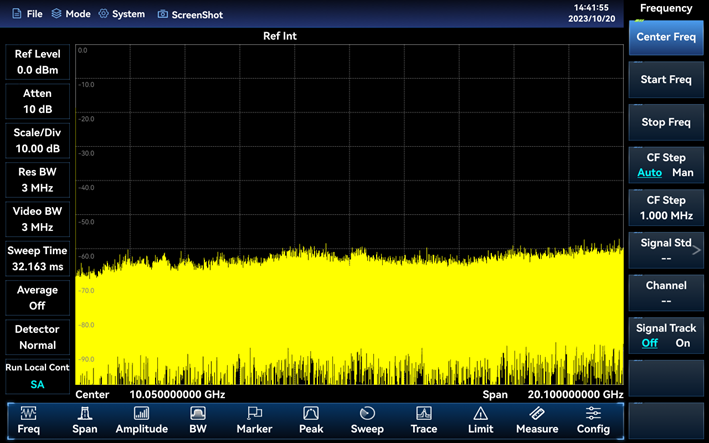
Sweep time <33ms (span 20GHz, resolution bandwidth 3MHz)
Sweep time<4s (span 1GHz, resolution bandwidth 1kHz, Fast FFT sweep mode)
Multiple measurement function modes
Spectrum analysis,real-time spectrum(maximum BW 40MHz),interference analyzer(spectrogram, RSSI),AM/FM/PM analyzer,channel scanner,field strength,power meter,peak-power meter,IQ analyzer,EMI analyzer,phase noise meter,vector signal analyzer,time gate, etc.
Multiple intelligent measurement functions
Channel power, OBW, ACPR, emission mask, C/N, harmonics and spur emissions,Tune Listen,multi-ACPR,IP3,CCDF, etc.
Various auxiliary test interfaces and digital interfaces
10MHz reference input and output, zero span IF output, LAN, USB, HDMI, etc
Convenient and quick user operation experience
12.1-inch capacitive touch screen, supporting multi-touch, with 6 independent markers, supporting signal tracking and peak tracking, with 3 display traces, 6 detection methods (standard, positive peak, negative peak, sampling, mean, root mean square), and supporting HDMI output
Support a variety of external options and accessories
such as USB CW power probe, USB peak power probe, EMI near field probe, etc.
Features
The 4042 series spectrum analyzer has such test functions as Channel power, OBW, ACPR, emission mask, C/N, harmonics and spur emissions,Tune Listen,multi-ACPR,IP3,CCDF, supports noise marker and frequency counter functions, and can display 3 tracks at the same time, with different detection methods including Normal, peak, negative peak, sample, Average and RMS, supporting signal tracking and peak tracking functions.
Interference Analyzer (option)
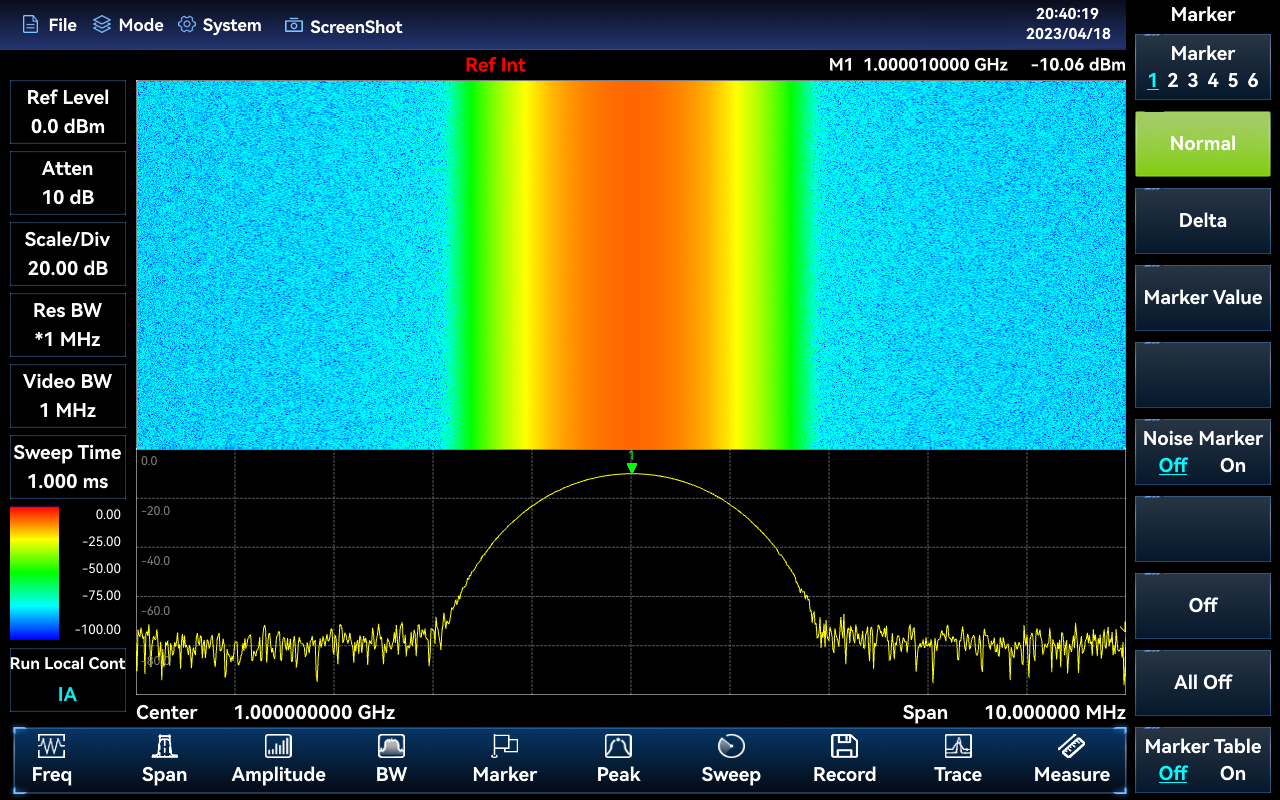
The interference analyzer option has spectrum , spectrogram and RSSI measurement. Spectrogram uses the frequency-amplitude-time three-dimensional display mode, which can conveniently observe periodic or intermittent signals. The different colors displayed in the waterfall plot reflect the strength of signal amplitude. RSSI (received signal strength indicator) is mainly used to measure the intensity change of a point frequency signal in a period of time. Both Spectrogram and RSSI measurement support the automatic storage of signals.
Channel Scanner (option)
The channel scanner measurement mode offers signal power measurement for multiple channels. The signal power is displayed in the form of bar graph or list, and the signal power of 20 channels can be measured at most. According to the channel setting method, it is divided into three measurement methods: channel scanner, frequency scanner, and list scanner. The bandwidth and number of channels can be set in all of the three measurement methods.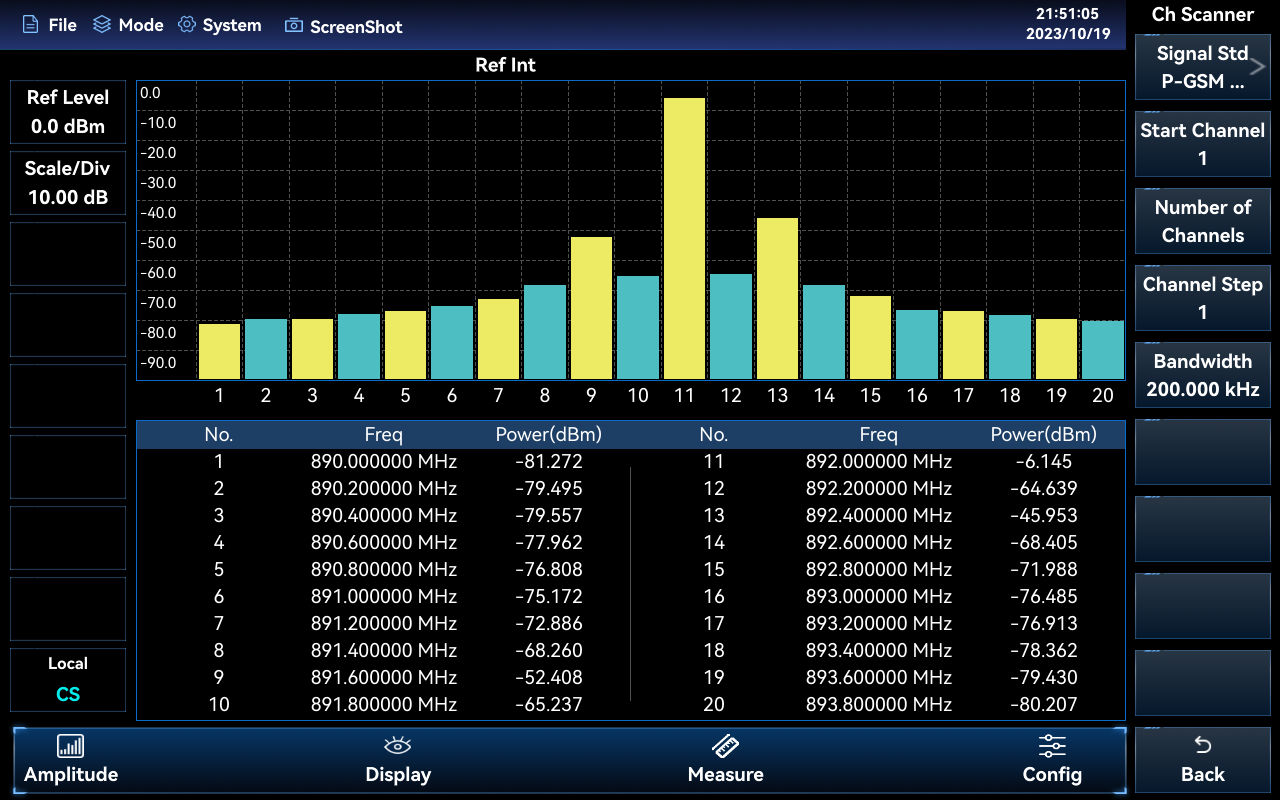
AM/FM/PM Analyzer (option)
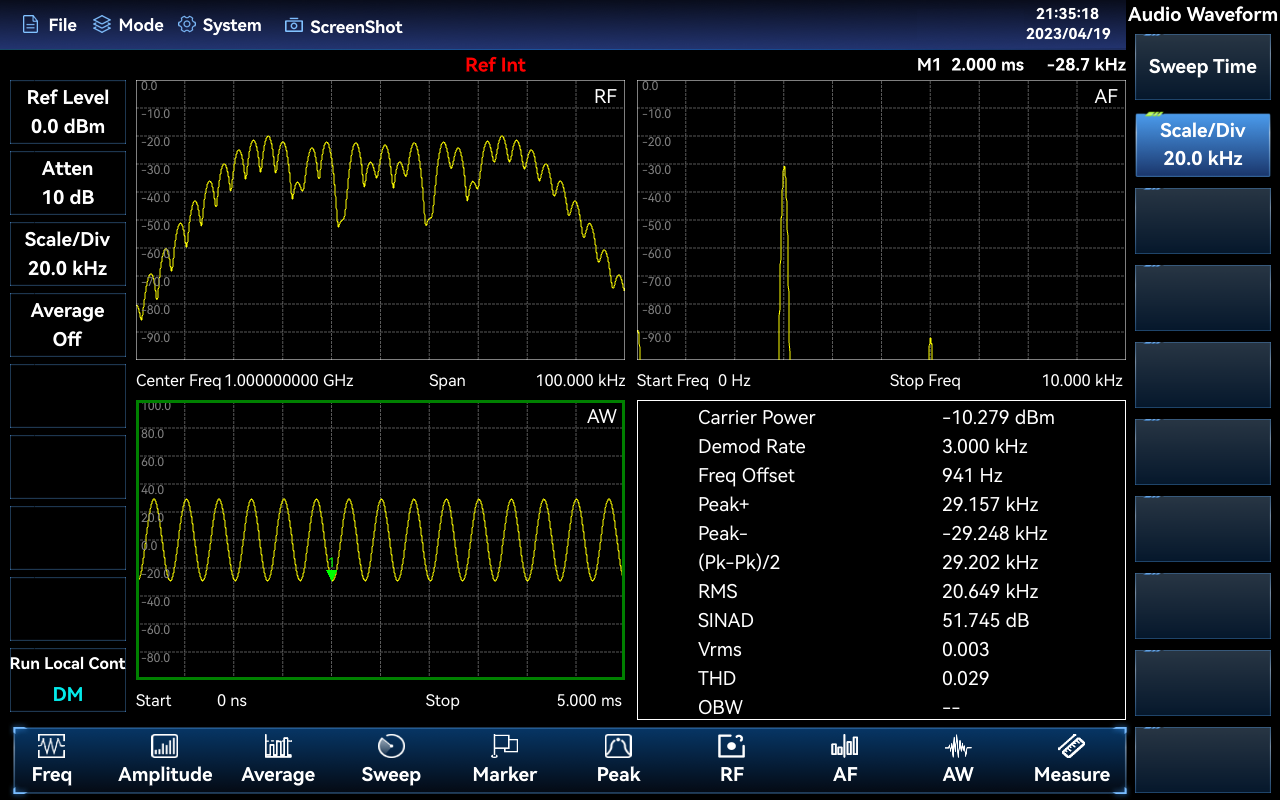
AM/FM/PM Analyzer measurement mode provides the display of AM, FM and PM signal spectrum and the analysis of related parameters. The main spectrum and related parameters are measured as follows:
RF spectrum: similar to the spectrum analysis mode, displaying the spectrum of the modulated signal and measuring the occupied bandwidth.
Audio spectrum: showing the spectrum of the demodulated audio signal.
Audio waveform: showing the waveform of the demodulated audio signal in the time domain.
Show all: measuring and analyzing parameters of the modulated signal including carrier power, modulation rate, carrier frequency offset, modulation depth (AM), modulation frequency offset (FM), modulation phase offset (PM), signal-to-noise ratio, modulation distortion and total harmonic distortion.
Power Meter (option)
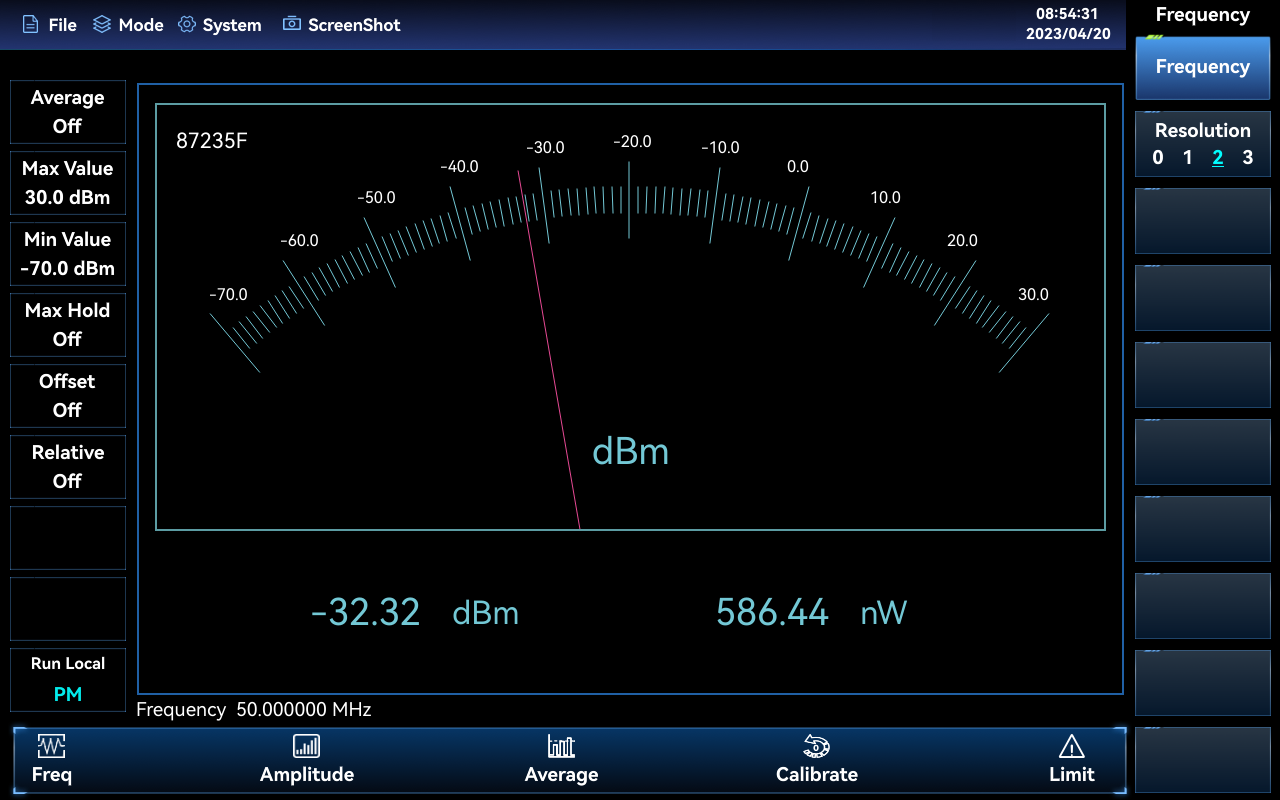
With the external USB power sensor of the Ceyear 87230/87231/84232/87233 series, the USB power measurement function can be used to measure CW signal power of up to 40GHz.
Peak-Power Meter(option)
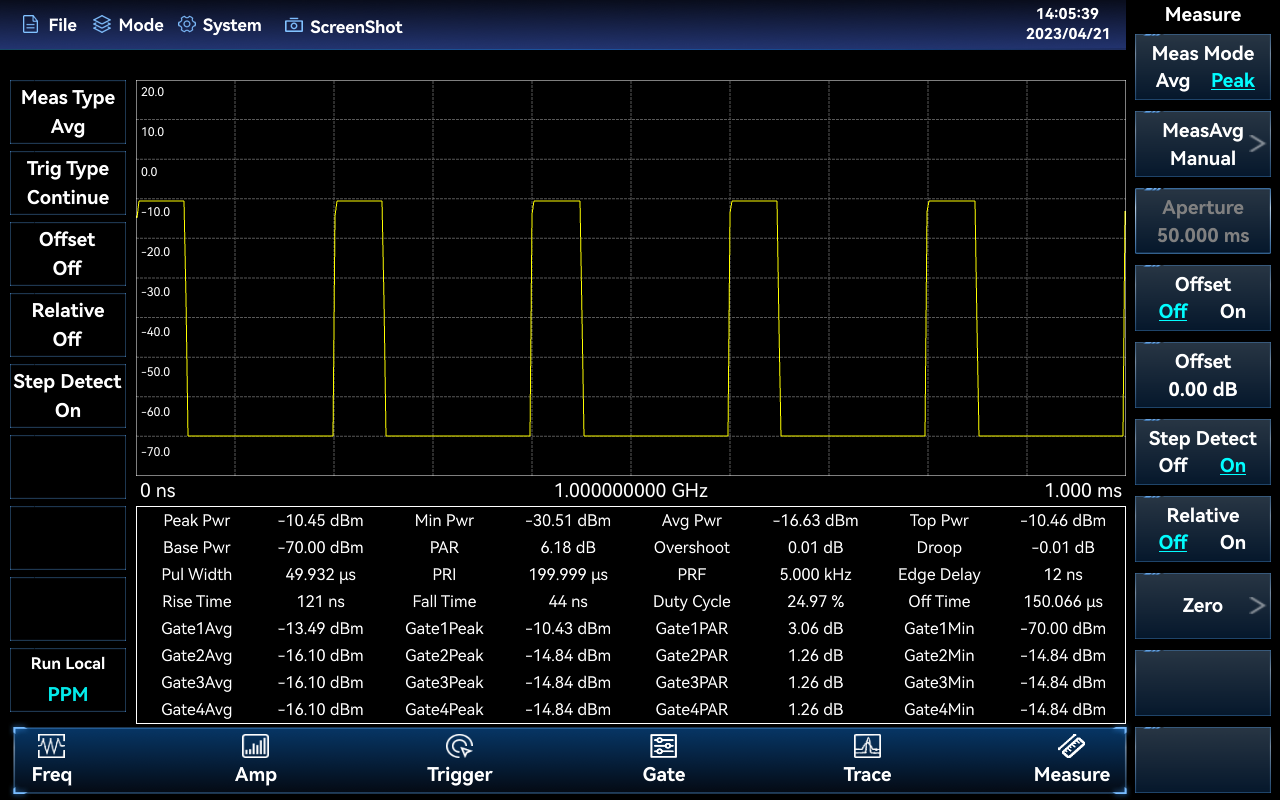
By connecting to the Ceyear 87234D/E/F/L USB peak sensor via the USB interface, this function can be used to test RF/microwave signals up to 67GHz, enabling pulse power measurement in a large dynamic range.
Field Strength (option)
Field strength measurement can be divided into three modes: PScan, FScan and MScan. Whereas, the PScan measurement can be used to observe the frequency offset, amplitude value and field strength value of the current point by setting the point frequency rate. The FScan measurement By setting the initial frequency, step frequency and sweep points, the amplitude and field strength changes in a frequency range can be observed.The MScan measurements can be used to observe amplitude values and field strength values at list frequency points by calling a pre-edited or saved list. 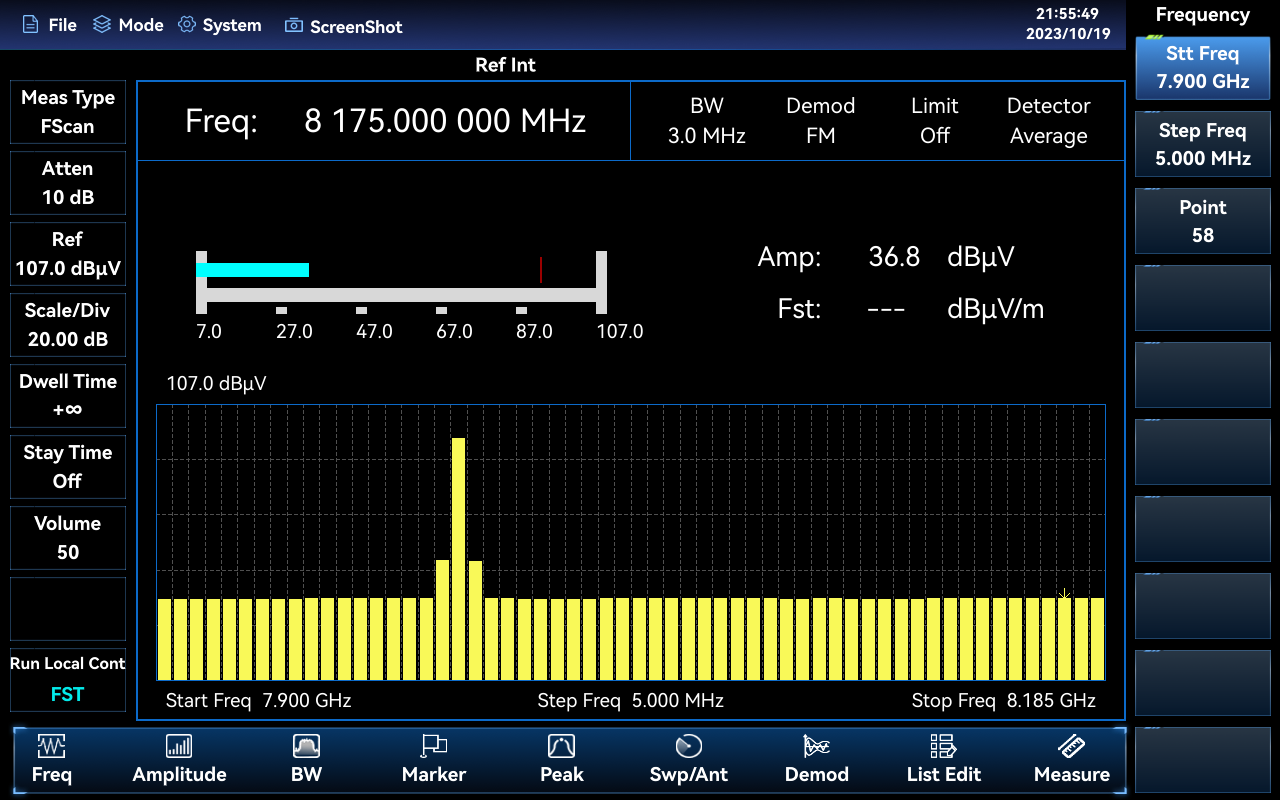
40MHz Real-time Spectrum AnalyZer (option)
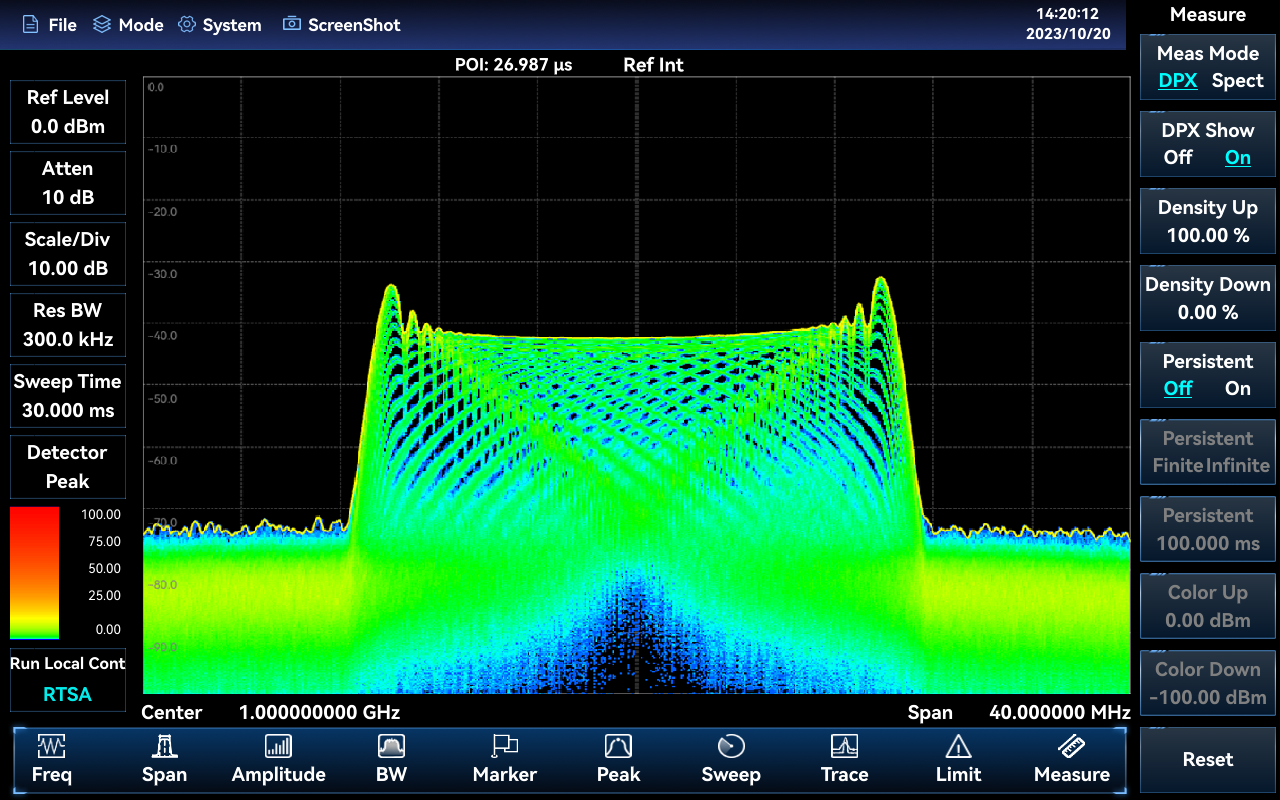
The real-time spectrum analyzer is mainly used for the capture and analysis of transient time-varying signals and burst signals. The real-time analysis bandwidth is up to 40MHz, which can realize the digital afterglow and waterfall plot measurement function of transient signals.
IQ Analyzer (option)
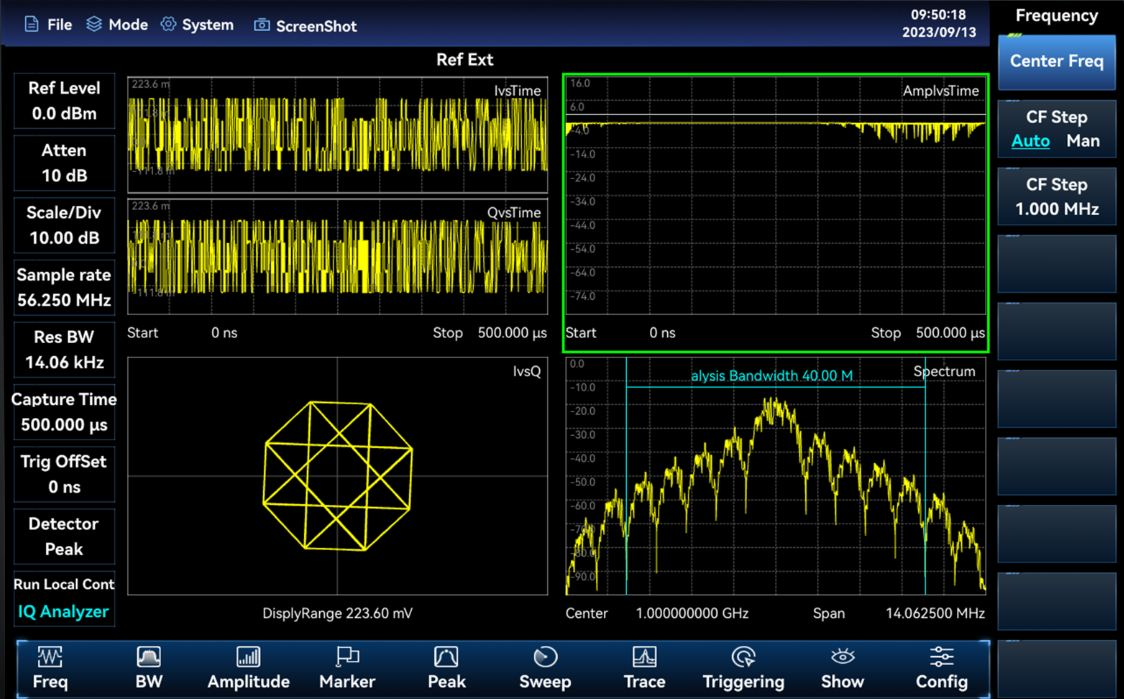
The IQ analyzer option supports the capture and display of IQ data as well as graphical display interfaces such as IQvs time, amplitude vs time, spectrogram and I vs Q.
specifications
| Model | 4042B/D |
| Frequency Range | 4042B: 9kHz~9GHz 4042D: 9kHz~20GHz |
| Frequency Reference | Nominal frequency: 10MHz Aging rate: ±5×10⁻⁷/year Initial frequency accuracy: ±3×10⁻⁷ Temperature stability: ±1×10⁻⁷ (0℃~+50℃, relative to 25℃±10℃) Frequency reference error:±(to last calibration date × aging rate + temperature stability + calibration accuracy) Note: By default, the time until the last calibration is 1 year. This indicator is guaranteed by the crystal oscillator manufacturer. |
| Sweep Time | Range: 1μs-6000s (zero span) Accuracy: ±1.0% (zero span) |
| Frequency Readout Accuracy | ±(frequency reading × frequency reference error + 1% × span + 10% × resolution bandwidth) |
| Span | Range: 0Hz (zero sweep width), 10Hz - upper limit of frequency range Accuracy: ±1.0% |
| RBW | Bandwidth range: 1Hz~20MHz (1-2-3-5-8 steps) |
| VBW | Bandwidth range: 1Hz~20MHz (1-2-3-5-8 steps) |
| SSB Phase Noise (Carrier 1GHz, +15℃~+35℃) | ≤-108dBc/Hz@10kHz, ≤-110dBc/Hz@100kHz ≤-118dBc/Hz@1MHz, ≤-129dBc/Hz@10MHz |
| Displayed Average Noise Level (50Ω load connected at input, 0dB input attenuation, average detector, RBW normalized to 1Hz, +15℃~+35℃) | Preamplifier ON: ≤-161dBm(2MHz~2.4GHz), ≤-160dBm(2.4GHz~6GHz), ≤-159dBm (6GHz~9GHz), ≤-158dBm (9GHz~14GHz), ≤-156dBm (14GHz~20GHz) Preamplifier OFF ≤-142dBm(2MHz~2.4GHz), ≤-141dBm(2.4GHz~6GHz), ≤-140dBm (6GHz~9GHz), ≤-138dBm (9GHz~14GHz), ≤-138dBm (14GHz~20GHz) |
| Second Harmonic Distortion (Attenuation 0dB, -30 dBm input, preamplifier OFF) | ≤-70dBc (50MHz~10GHz) |
| TOI (-15 dBm dual tone signal, 100 kHz spacing, 0dB attenuation, preamplifier OFF) | ≥+13 dBm (50MHz ~ 20GHz) |
| Image, Multiple and Out-of-band responses (-10dBm mixer level) | <-65dBc (10MHz~7.5GHz), <-60dBc (7.5GHz~10.5GHz), <-65dBc (10.5GHz~20GHz) |
| Residual response (50 Ω load connected to input port, 0 dB input attenuation) | Preamplifier ON: ≤-110dBm (10MHz~3GHz), ≤-105dBm (3GHz~9GHz) ≤-103dBm (9GHz~12GHz), ≤-100dBm (12GHz~20GHz) Preamplifier OFF: ≤-90dBm (10MHz~20GHz) |
| Absolute Amplitude Accuracy (Frequency 10MHz~20GHz, attenuation 10dB, 0 dBm~-50 dBm, preamplifier OFF, RBW 1kHz, other parameters automatic) | ±1.30 dB (working temperature: +15℃~+35℃) |
| Input Attenuator | Attenuation range 0dB-30dB, 2dB step |
| Maximum Input Level | +27dBm CW (input) frequency ≥50 MHz, attenuation ≥ 10dB , preamplifier OFF) |
| Reference Level | Range: -150 dBm ~ +30 dBm, min step 1dB Conversion error: ±0.50dB (reference level 0 dBm~-60 dBm) |
| Detector Type | Normal, PosP, NegP, Smp, Avg, Rms. |
| Dimensions | 377mm (W) ×250mm (H) ×119.5mm (D) (the padding block is closed, without protrusions such as handles, rotary pulse generators and adapters) |
| Weight | ≤6.5kg |
| Working Temperature: | 0℃~+50℃ |
| Storage Temperature | -40℃~+70℃ |
| Electromagnetic Compatibility | Complies with relevant requirements of 3.9.1 in GJB 3947A-2009 |
| Power Supply | 100~120VAC, 50~60Hz; or 200~240VAC, 50~60Hz |
| Power Consumption | ≤55W |
| Test Interface | RF input: N-type female connector |
| Other Interfaces | 10MHz reference input/output: BNC female External trigger input interface: BNC female GPS antenna interface: SMA female (option, reserved) IF output interface output: BNC female (option) Wi-Fi antenna interface: SMA female (option, reserved) |
| Communication and Auxiliary Interfaces | Front panel: 1 USB3.0 A-type interface, 1 USB2.0 A-type interface Rear panel: 2 USB2.0 A-type interfaces, 1 USB3.0 B-type interface (reserved) 1 USB 2.0 C-type interface, LAN interface: standard RJ-45 type 1 HDMI interface |
Host Model
| Numbering | Name | Describe |
| 4042D | Spectrum Analyzer | 9kHz-20GHz |
| 4042B | Spectrum Analyzer | 9kHz-9GHz |


 MakeWebEasy